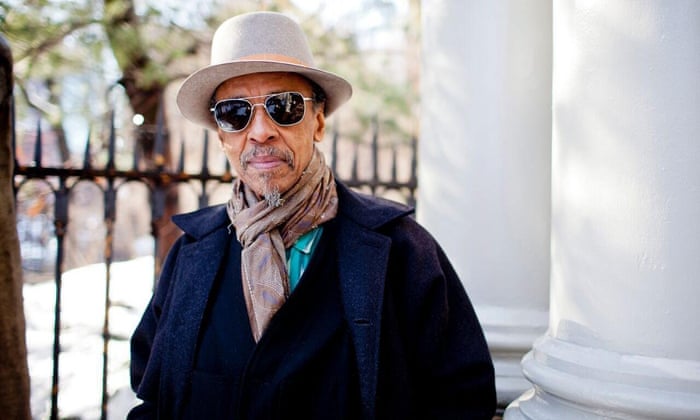
If I'm not mistaken, this is the third time a "jazz musician" has won the Pulitzer. Wynton Marsalis won in 1997 for his (in my opinion) rather workman-like Blood on the Fields, a retelling through music of the African-American experience, which pales in comparison to the similarly themed "Roots and Folklore" by John Carter, which I have praised in this space on several occasions.
Showing posts with label Ornette Coleman. Show all posts
Saturday, April 23, 2016
Congratulations Henry Threadgill
If I'm not mistaken, this is the third time a "jazz musician" has won the Pulitzer. Wynton Marsalis won in 1997 for his (in my opinion) rather workman-like Blood on the Fields, a retelling through music of the African-American experience, which pales in comparison to the similarly themed "Roots and Folklore" by John Carter, which I have praised in this space on several occasions.
Thursday, October 8, 2015
Top 8 for October 8, 2015
Haven't done this in quite a while, but it was a good music day.
You may know it as the that three note piano piece from Eyes Wide Shut, but it's hauntingly effective in its simplicity.
Pierre-Laurent Aimard - Musica Ricecarata - II: Mesto, rigido e cerimoniale
from the György Ligeti Edition, Volume 3You may know it as the that three note piano piece from Eyes Wide Shut, but it's hauntingly effective in its simplicity.
Roxy Music - For Your Pleasure
The title song from their second album, Brian Eno's presence is strongly felt, just before his absence was.J. S. Bach - Brandenburg Concerto No. 3
Wednesday, June 24, 2015
Lonlier Woman
Friday, June 12, 2015
Ornette Coleman, RIP
I barely have time to write this, but I must mark the passing of Ornette Coleman, one of the most significant musicians of the last, or perhaps any century. As the headline to Ben Ratliff's obituary said, he rewrote the language of jazz, and, as Ratliff later writes, "widened the options in jazz and helped change its course... [making jazz] less beholden to the rules of harmony and rhythm".
I'll write more, but I'm currently overwhelmed at the other end of musical history, but I've hastily arranged for my 85th birthday tribute to Ornette to be this week's webcast.
Saturday, March 14, 2015
Playlist for the Unpopular Music webcast, March 14, 2015
Today we celebrate the 85th birthday of Ornette Coleman, one of the truly transformative musical figures of the 20th century. In order to follow the rules for internet radio there are only four performances by the master, but the remainder of the show is made up of Ornette's compositions played by others, often by musicians with only one degree of separation.
Friday, March 13, 2015
Preview for Saturday's webcast
The catch, of course, is having to follow the rules of the Digital Millennium Copyright Act, which means I can play no more than four (4) tracks with "Ornette Coleman" in the artist field. So, we'll largely be featuring Ornette as composer with a selection of artists playing his tunes.
Also conspicuously absent will be the new New Vocabulary album. Since Ornette is a group member, and not listed as the "artist", I could conceivably play three tracks. But, System Dialing Records is offering it at such a high price, even for the downloads, I haven't been able to bring myself to buy it.
For another, most likely better, tribute, follow the link on the right to Charlie Kohlhase's tribute on the March 9th episode of Research and Development which should be available through next Sunday (the 21st). (I've been waiting until I finished this to check it out.) Charlie gets a pass on my birthday tribute fist-shaking, as he usually features tributes to musicians I need to learn more about.
Tuesday, January 27, 2015
The Bad Plus present Science Fiction at the Berklee Peformance Center, Jamuary 24, 2015
Here's an oversimplification of the difference between "classical music" and "jazz".1
In classical music the performers are tasked with recreating a musical experience that has been recorded in a notated document for this purpose, whereas in jazz the performers create in the moment using some sort of predetermined framework as a jumping-off point.
In classical music, the performer transforms the prerecorded information into live sounds to the best of his understanding of the composer's intentions, bringing to life the music in the composer's mind at the time he wrote it down.2 In jazz, there are various traditions to writing things down, from full fledged everything-notated-all-the-way-through, to some sort of "you play what you feel like when I point at you" approaches to all points in between.
Let's take Duke Ellington for example. It's obvious when listening to his music, there's a lot of stuff written out. But, if you've ever heard a recording of a rehearsal or recording session out-takes, you'll learn that things could change on-the-fly if a better idea came along. And there's always the spontaneity of the moment. For instance, at the 1956 Newport Jazz Festival, Ellington determined that between the mostly written-out pieces "Diminuendo in Blue" and "Crescendo in Blue" there would be a "blues interlude" where Paul Gonsalves would improvise over the standard blues form for an indeterminate length of time. As it turned out, Gonsalves' momentum and the audience's frenzied reaction sustained this interlude for 27 choruses (or about six minutes).3
In classical music the performers are tasked with recreating a musical experience that has been recorded in a notated document for this purpose, whereas in jazz the performers create in the moment using some sort of predetermined framework as a jumping-off point.
In classical music, the performer transforms the prerecorded information into live sounds to the best of his understanding of the composer's intentions, bringing to life the music in the composer's mind at the time he wrote it down.2 In jazz, there are various traditions to writing things down, from full fledged everything-notated-all-the-way-through, to some sort of "you play what you feel like when I point at you" approaches to all points in between.
Let's take Duke Ellington for example. It's obvious when listening to his music, there's a lot of stuff written out. But, if you've ever heard a recording of a rehearsal or recording session out-takes, you'll learn that things could change on-the-fly if a better idea came along. And there's always the spontaneity of the moment. For instance, at the 1956 Newport Jazz Festival, Ellington determined that between the mostly written-out pieces "Diminuendo in Blue" and "Crescendo in Blue" there would be a "blues interlude" where Paul Gonsalves would improvise over the standard blues form for an indeterminate length of time. As it turned out, Gonsalves' momentum and the audience's frenzied reaction sustained this interlude for 27 choruses (or about six minutes).3
Subscribe to:
Posts (Atom)
