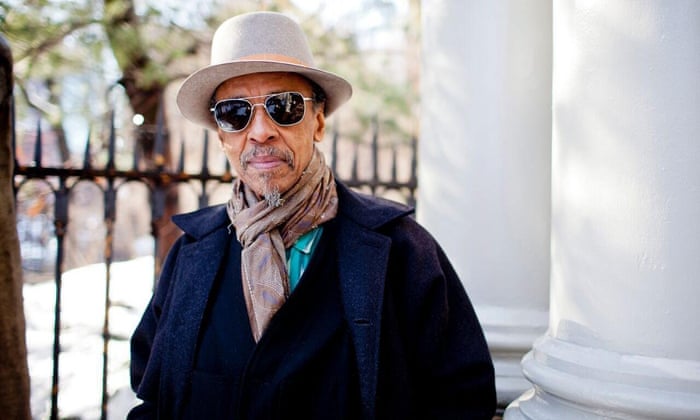
If I'm not mistaken, this is the third time a "jazz musician" has won the Pulitzer. Wynton Marsalis won in 1997 for his (in my opinion) rather workman-like Blood on the Fields, a retelling through music of the African-American experience, which pales in comparison to the similarly themed "Roots and Folklore" by John Carter, which I have praised in this space on several occasions.
Showing posts with label Wynton Marsalis. Show all posts
Saturday, April 23, 2016
Congratulations Henry Threadgill
If I'm not mistaken, this is the third time a "jazz musician" has won the Pulitzer. Wynton Marsalis won in 1997 for his (in my opinion) rather workman-like Blood on the Fields, a retelling through music of the African-American experience, which pales in comparison to the similarly themed "Roots and Folklore" by John Carter, which I have praised in this space on several occasions.
Tuesday, January 27, 2015
The Bad Plus present Science Fiction at the Berklee Peformance Center, Jamuary 24, 2015
Here's an oversimplification of the difference between "classical music" and "jazz".1
In classical music the performers are tasked with recreating a musical experience that has been recorded in a notated document for this purpose, whereas in jazz the performers create in the moment using some sort of predetermined framework as a jumping-off point.
In classical music, the performer transforms the prerecorded information into live sounds to the best of his understanding of the composer's intentions, bringing to life the music in the composer's mind at the time he wrote it down.2 In jazz, there are various traditions to writing things down, from full fledged everything-notated-all-the-way-through, to some sort of "you play what you feel like when I point at you" approaches to all points in between.
Let's take Duke Ellington for example. It's obvious when listening to his music, there's a lot of stuff written out. But, if you've ever heard a recording of a rehearsal or recording session out-takes, you'll learn that things could change on-the-fly if a better idea came along. And there's always the spontaneity of the moment. For instance, at the 1956 Newport Jazz Festival, Ellington determined that between the mostly written-out pieces "Diminuendo in Blue" and "Crescendo in Blue" there would be a "blues interlude" where Paul Gonsalves would improvise over the standard blues form for an indeterminate length of time. As it turned out, Gonsalves' momentum and the audience's frenzied reaction sustained this interlude for 27 choruses (or about six minutes).3
In classical music the performers are tasked with recreating a musical experience that has been recorded in a notated document for this purpose, whereas in jazz the performers create in the moment using some sort of predetermined framework as a jumping-off point.
In classical music, the performer transforms the prerecorded information into live sounds to the best of his understanding of the composer's intentions, bringing to life the music in the composer's mind at the time he wrote it down.2 In jazz, there are various traditions to writing things down, from full fledged everything-notated-all-the-way-through, to some sort of "you play what you feel like when I point at you" approaches to all points in between.
Let's take Duke Ellington for example. It's obvious when listening to his music, there's a lot of stuff written out. But, if you've ever heard a recording of a rehearsal or recording session out-takes, you'll learn that things could change on-the-fly if a better idea came along. And there's always the spontaneity of the moment. For instance, at the 1956 Newport Jazz Festival, Ellington determined that between the mostly written-out pieces "Diminuendo in Blue" and "Crescendo in Blue" there would be a "blues interlude" where Paul Gonsalves would improvise over the standard blues form for an indeterminate length of time. As it turned out, Gonsalves' momentum and the audience's frenzied reaction sustained this interlude for 27 choruses (or about six minutes).3
Subscribe to:
Posts (Atom)
